
Chicago-Based Novelist Della Leavitt on Her Debut, VIVIAN'S DECISION

📕 New book alert: Eric Beck Rubin’s Ten Clear Days will be published on April 14: “When Eric Beck Rubin’s grandmother, a Holocaust survivor, requests medical assistance in dying, it divides her family. Over ten increasingly tense days, we come to know her story and its final outcome.”
Aug. 8 - 14 in Valencia, CA at CalArts, hosted by Vermont College of Fine Arts, a summer fiction workshop I’m scheduled to teach: “The Long and the Short of It,” open to all writers & part of VCFA’s annual writers conference. Registration form is here & more info on the various workshop offerings is here.
A preview of last week’s post, April’s agent query list, is available here. Bookish subscriptions are currently 30% off. 📗
Greetings fellow literary travelers and welcome new subscribers!
Today’s post is an interview with Chicago-based writer Della Leavitt, whose debut novel, Vivian’s Decision, will be published on Tuesday, April 14. Della is a generous and supportive participant in the Chicago literary community, and she’s also an excellent example of a tenacious and talented writer who has worked hard on developing her voice and style on the page.
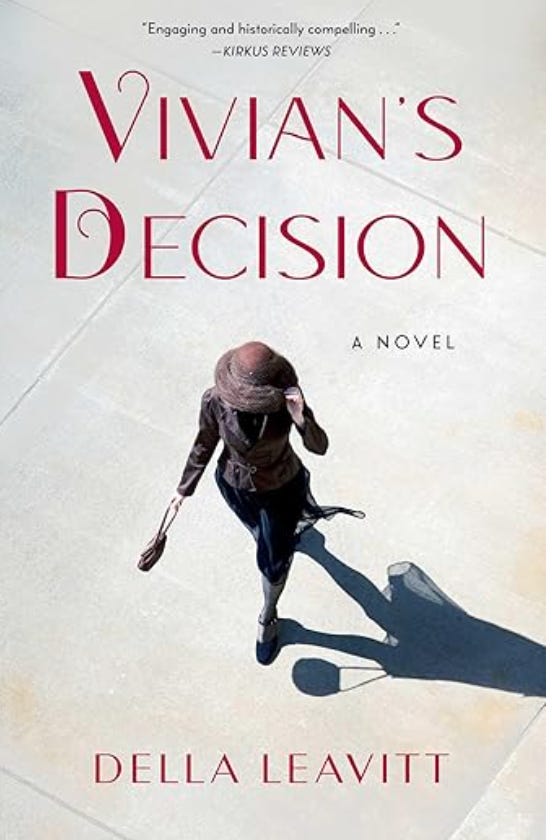
Before our interview, here’s a summary of Vivian’s Decision (adapted from the jacket copy):
When Vivian Jacobson, a mother of four, learns she’s pregnant again, she can’t imagine adding a fifth child to the family. Her husband Mel is a devoted partner, but works long days in his family’s Maxwell Street tavern, leaving Vivian isolated and overwhelmed in their suburban Chicago home. She pleads with Mel to permit her to have an abortion, Mel reluctantly agreeing.
Her doctor won’t risk his license but refers her to someone who will. Once she finds herself in the abortionist’s disgusting makeshift flat, she can’t go through with the procedure. As she flees, the man warns her the clock is ticking: if she decides to end the pregnancy, she must return within the week. As Vivian struggles with what to do next, she’s buffeted by a series of revelations, including her Jewish immigrant mother's parallel secret. Ultimately, she must find the courage to make the decision that is best for her family—and her own fulfillment.
Christine/Bookish: What inspired you to write Vivian’s Decision? Was there a particular memory, experience, or question?
Della Leavitt: One of my late aunts shared a phrase that a hostile druggist used to rebuke my pious Russian Jewish immigrant grandmother: “If you don’t want this baby, I’ll take him!” I wondered about that encounter and my sickly Grandma Della’s powerlessness to control childbearing and her associated health risks. She died young and each of her seven children named a child in her memory.
In early drafts of Vivian’s Decision, Vivian’s immigrant mother Hannah was the protagonist.
During subsequent revisions, as I explored Hannah’s daughter Vivian’s story, it became clear that women who bore children in the 1950s faced similar constraints to those of preceding generations. The novel evolved to become Vivian’s story alongside sections that reflect back to her mother’s experiences in the 1920s.
CS: The novel is set in north suburban Chicago and the Maxwell Street area of the city. How did place shape the emotional and social pressures Vivian faces?
DL: Vivian’s Decision highlights the generational tensions between immigrants’ Old World traditions and the next generation’s aspirations amid American post-WWII hubris. Vivian and her husband Mel Jacobson are keen to assimilate into mainstream suburban culture despite explicit anti-Semitic attitudes and housing restrictions. Chicago’s Maxwell Street marketplace was the landing place for waves of European immigrants and African American migrants from the South.
Vivian and Mel’s parents arrived there at the turn of the 20th century, having fled murderous pogroms from the Russian tsar and his cossacks. Although Vivian’s husband Mel continues to work in his family’s Maxwell Street delicatessen-turned tavern, Vivian aches to distance herself from that world and offer their children the opportunities for college that she and Mel were denied as children growing up during the Depression.
Vivian yearns for an independent identity outside the home, yet at the same time, she’s conflicted about measuring up to the impossible 1950s ideal of dutiful wife and perfect mother.
CS: What research went into portraying reproductive healthcare in the 1950s, and how did you balance historical accuracy with narrative momentum?
DL: NYC’s Tenement Museum’s virtual “tenement talk” about the history of birth control in the 19th and 20th centuries was my introduction to the punishing Comstock Act of 1873 that criminalized sending birth control and abortion-related items through the U.S. mail.
Research librarians at the Chicago History Museum’s Abramowicz Research Center, the Special Collections of the Chicago Public Library at the Harold Washington Library Center, and the Newberry Library guided me to sources about home births through the Chicago Maternity Center (1895-1973) details and national statistics from volumes written in the 1930s and 1940s. I revisited the documentary film, The Chicago Maternity Center Story (Kartemquin Films, 1976).
I wove that information into the novel’s arc along with narratives gleaned from various anecdotal accounts. One critique partner’s mother was a nurse in a local hospital that routinely performed elective D & C’s before Roe v. Wade. Many novels portray women’s desperation when contemplating an illegal abortion such as Joan Didion’s Run, River (1963), Richard Yates’s Revolutionary Road (1961), and Jennifer S. Brown’s Modern Girls (2016) where a 1935 Jewish mother and daughter are both pregnant at the same time.
CS: You resist simple answers and easy judgments in this novel. How did you navigate writing about abortion without turning the book into an argument?
DL: I state the obvious to say abortion has become an increasingly polarizing issue across today’s political spectrum. Yet despite efforts to codify restrictive laws surrounding reproduction options, abortion remains a deeply personal choice, no matter one’s political stance or religious beliefs. There are many reasons why a woman might consider taking this action. Her ultimate decision is not clear-cut, nor formulaic.
When I explored Vivian and her loving husband Mel contemplating termination of her fifth pregnancy, my goal was to portray the multi-faceted, complex nature of this decision. The poem “The Mother” (1945) by Pulitzer Prize winner, Chicagoan Gwendolyn Brooks, is important to the novel. A guide from the Poetry Foundation describes this poem as “neither pro nor con abortion.” I had a similar goal for Vivian’s Decision. From your question, I’m gratified to see that you believe that I accomplished this goal.
CS: I know it was an odyssey to find the right home for Vivian’s Decision - would you say a little about how you decided on She Writes Press?
DL: After years writing and revising this novel, winning a grant from Chicago’s Department of Cultural Affairs & Special Events (DCASE) and a fellowship from the Newberry Library, I continue to believe in this story and sought a publishing option poised to best reach readers.
I was thrilled when award-winning She Writes Press, founded in 2012, offered me a contract. I appreciate the press’s emphasis on collaboration with my sister authors and direct communications with publisher Brooke Warner and her dedicated staff. Given my longtime support of independent bookstores, She Writes Press’s distribution arm, Simon & Schuster, gives readers the opportunity to order my book through the indie bookstore of their choice.
My two launch events on April 14, 6:30 PM, at the Book Cellar in Chicago’s Lincoln Square neighborhood in conversation with Abby Geni, and on April 27, 6 PM, at Winnetka’s Book Stall in conversation with Lindsay Hunter, would not be possible without this traditional distribution channel. Also, I was excited to learn that Chicago’s Women & Children First and Judy Blume’s Books & Books in Key West will also carry Vivian’s Decision on launch day.
CS: What are you working on now?
DL: Many fellow workshop participants and editors have found two key secondary characters of Vivian’s Decision to be particularly intriguing: Vivian’s bossy, unmarried older sister Ethel Kolson, and Vivian’s mother’s bohemian friend “Aunt” Ruthie Lavin, who befriended Hannah when Ruth overheard her praying for a miscarriage in the women’s balcony of the old synagogue.
My new novel-in-progress takes place in 1930s Chicago where Aunt Ruthie takes Ethel on trips to the infamous Dill Pickle Club in Chicago’s artsy Towertown neighborhood and Ethel brings ten-year-old Vivian to see Sally Rand’s fan dance at the 1933 Chicago World’s Fair, the Century of Progress.
—
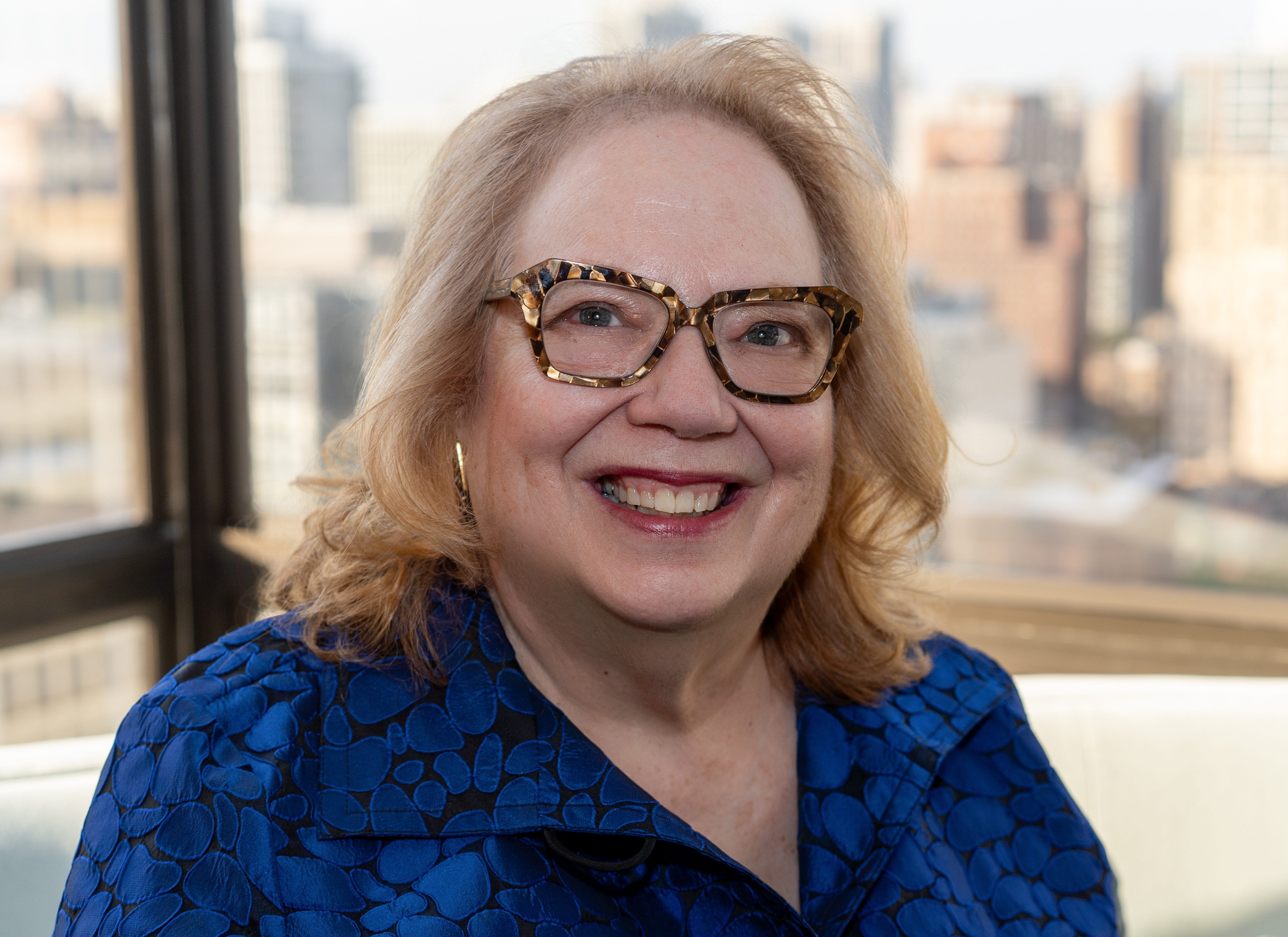
After careers in technology and math education, Chicagoan Della Leavitt turned to learning the art of writing fiction amid the vibrant Midwestern literary community, including the long-running Off Campus Writers’ Workshop (OCWW). In the early 1970s, the author, a first-generation college graduate, joined the Chicago Women’s Liberation Union, sharing a feminist vision of a society to transform women’s personal, professional, and political lives. Years later, in her debut historical novel, Vivian’s Decision, Della contrasts 1950s-era pressures to be a dutiful wife and perfect mother against a woman’s yearnings for an independent identity. Given the current rise of punishing laws restricting women’s reproductive freedoms, Vivian’s Decision is all too relevant and timely.
📗
NB: Della’s fast-approaching launch events for Vivian’s Decision:
* Tuesday, April 14, 6:30 PM, the Book Cellar, 4736–38 N. Lincoln Avenue, Chicago, with Abby Geni
* Monday, April 27, the Book Stall, 811 Elm Street, 6 PM, Winnetka, IL with Lindsay Hunter
Looking forward to this book! My second one-woman show is called JUMPING OFF THE FRIDGE - which was one way my grandmother, born in 1901 and immigrated from Austria at 12 yrs old to the tenements of the Lower East Side, tried to abort herself. (Also throwing herself down the apartment building stairs.)She ultimately had 9 kids and would’ve had more but her oldest daughter, a rebel, took her to see Margaret Sanger for a diaphragm. My grandmother got pregnant anyway with it - twins no less! And is famous for telling Sanger, “take this thing back! Before it I was having one at a time, now I’m having two!”
This sounds great. Maybe I can go on Tuesday.